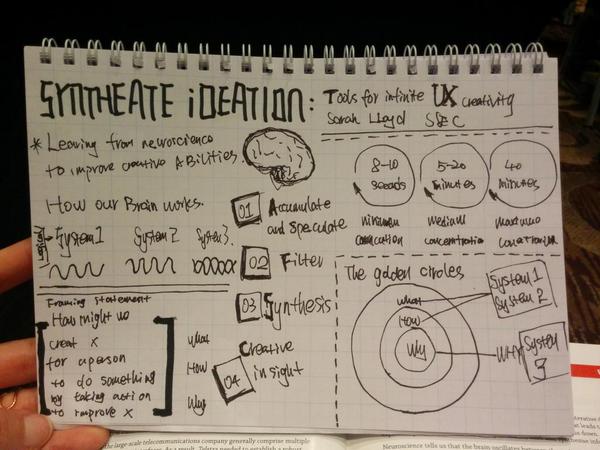
Syntheate ideation: Tools for infinite UX creativity
In the age of the cloud, where computers can be programmed to do iterative design, human brains have become bottlenecks for the type of information processing that leads to innovation. Rather than aiding the overall UX design process, our brains can actually slow us down. As designers we need to explore ways that maximise our ability to collect, filter and synthesise information. Neuroscience tells us that the brain oscillates between the task-positive and task-negative networks during synthesis and ideation every 10 seconds. The oscillation between a more action orientated state of mind, and one that is more restful, often including activities such as daydreaming and future gazing, plays an important role in creativity. Yet very little has been done to date to connect neuroscience with UX. Drawing on real-life industry practice and neuroscientific theory, this talk will demonstrate how to better create and synthesise ideas. It will also highlight how an understanding of the cyclical nature of our brain's neural physics can enhance UX design. Employing a deliberate narrative structure and adapting existing design methods with activities that work constructively within these two brain states, we invite you to experience a new approach to creativity. This is a talk for anyone looking to create better ideas for more meaningful user experiences.
Resources
Books:
- Daniel Kahneman, 2011: Thinking fast and slow
- Ned Herrmann, 1991: The creative brain
Articles & Talks
- Simone m. Ritter, 2012: Diversifying experiences enhance cognitive flexibility
- Charles Limb, 2010: Your brain on improv
- Simon Sinek, 2009: How great leaders inspire action
- John Kounios, 2012: The neuroscience behind epiphanies 2012
- Mark Beeman, 2012: The Creative Brain – Where Do Ideas Come From?
- Rex Jung, 2011: Creativity and the Brain
- Andreas Fink, 2010: Enhancing creativity by means of cognitive stimulation: Evidence from an fMRI study
- The Meditating Brain, 2011